Dynamic Layers
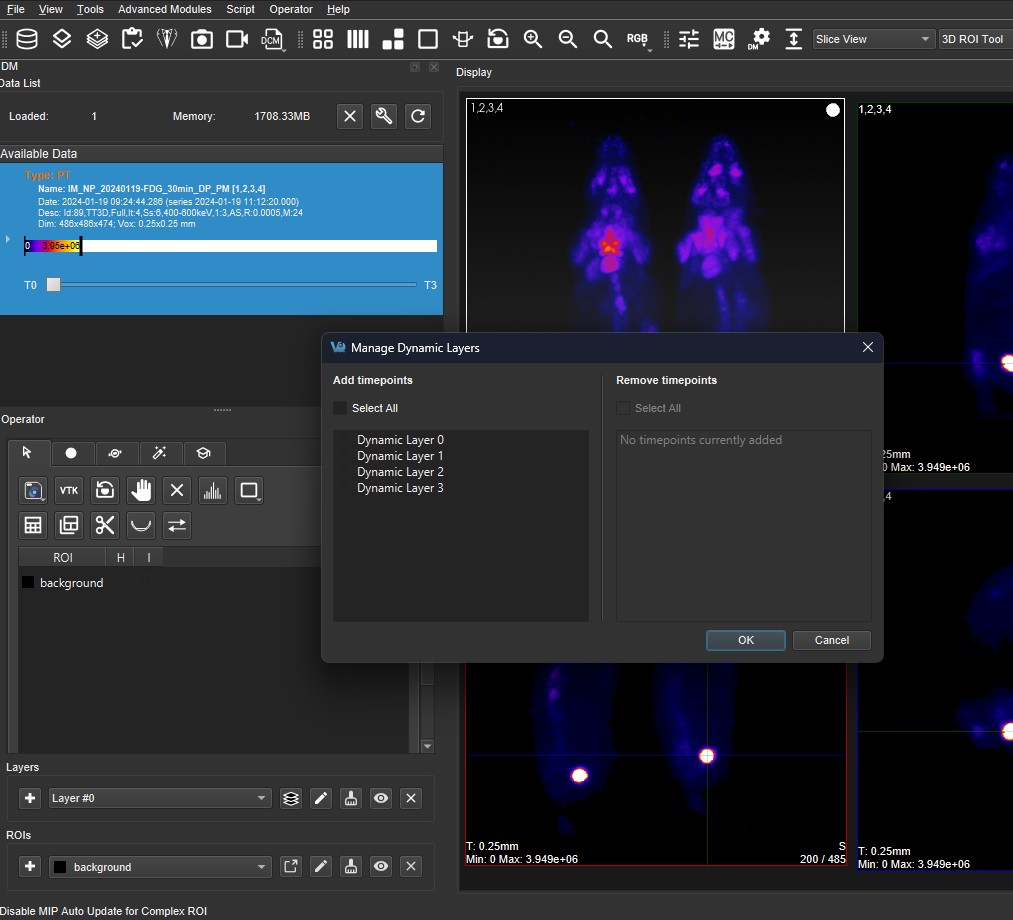
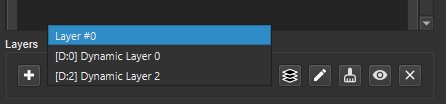
Dynamic layers are ROI layers that are linked to specific timepoints in a multi-timepoint dataset. Unlike static layers, which apply globally across all timepoints, each dynamic layer is associated with a particular timepoint index and will automatically be selected as you navigate through the data. To manage dynamic layers, click the Dynamic Layers button to open the management dialog, where you can add layers for any timepoints not yet covered, or remove existing ones. If a timepoint has no exact dynamic layer match, the nearest lower timepoint’s layer will be used as a fallback.
Dynamic Layer Limits & Lifecycle
Since both static and dynamic layers store ROI data at the same per-voxel resolution, the ability to extend well beyond the eight-layer static cap means memory requirements scale directly with the number of timepoints — so users should be judicious when deciding how many dynamic layers to create. Dynamic layers are intended for cases where an organ or structure visibly changes in size or shape across timepoints, such as in enhanced multi-frame PET or MR acquisitions, and are not necessary if a single static ROI adequately captures the region throughout the scan. Dynamic layers are also data-driven by design: they can only be created when multi-timepoint data is detected, and are automatically removed when their corresponding dynamic data is unloaded, keeping your ROI state always consistent with the data on screen.
Why Dynamic Layers
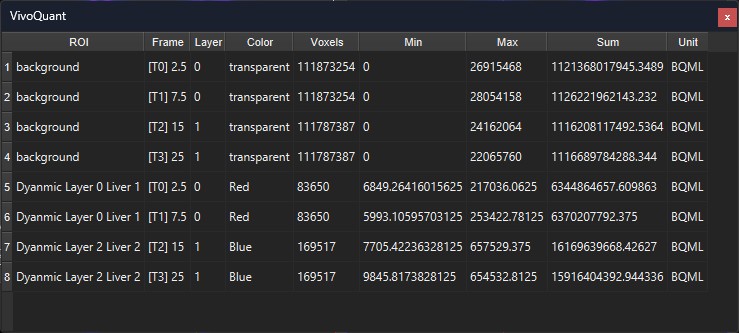
With static layers, every ROI is evaluated against every timepoint — so a two-ROI, four-timepoint study would still produce eight rows per ROI, most of which are meaningless pairings. Dynamic layers eliminate this by binding each ROI layer to the timepoint it was actually drawn for. In the table below, Dynamic Layer 0 (drawn at the earlier timepoints) contributes exactly its two ROIs at T0 and T1, while Dynamic Layer 2 contributes its two ROIs at T2 and T3 — eight rows of clean, intentional data instead of a bloated table where you’d have to manually ignore irrelevant layer/timepoint combinations. This is especially valuable as datasets grow: a ten-timepoint study with several ROIs per layer would otherwise generate a table an order of magnitude larger, with the meaningful rows buried among noise.